Storied [Art] Matter
Methodological Approaches across Material Engagement and Aesthetics
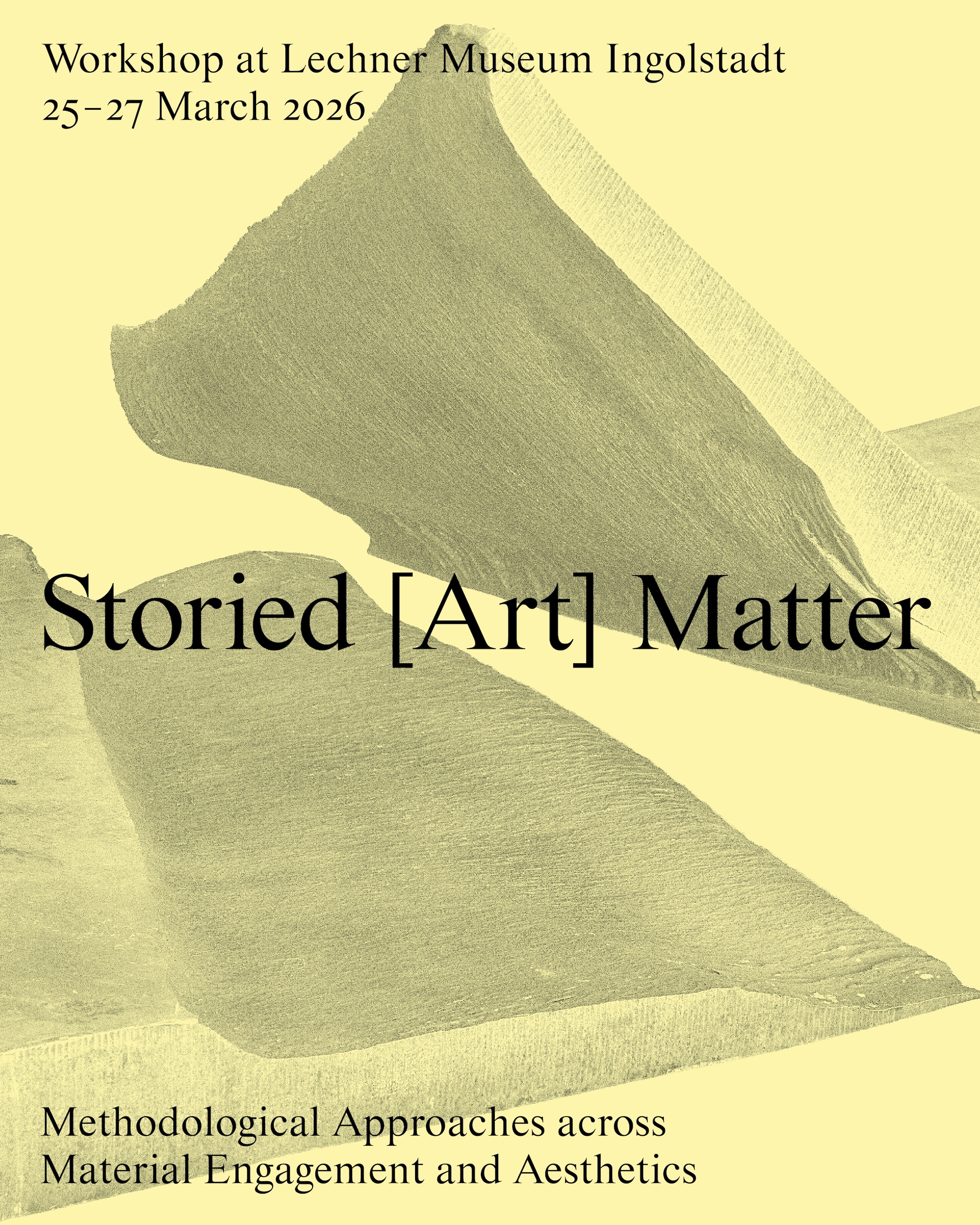
Storied [Art] Matter
Methodological Approaches across Material Engagement and Aesthetics
workshop I 25 – 27 March 2026 I Lechner Museum
The workshop will explore methodological experiments and alternative approaches to narrating material culture, with a particular focus on three-dimensional objects. Participants will examine the stories we tell about materials, as well as the stories that the materials themselves embody, creating a dialogue between material agency and aesthetic interpretation. Through hands-on methodologies such as fieldwork, material science and engagement with materials, alongside ecocritical theoretical frameworks, the event will bring together new approaches to researching the ‘storied matter’ of artistic production.
‚[…] the stories of matter are everywhere: in the air we breathe, the food we eat, in the things and beings of this world, within and beyond the human realm. All matter, in other words, is a „storied matter“.‘
The above statement, taken from Serenella Iovino and Serpil Oppermann’s book Material Ecocriticism (2014, 19), outlines a theoretical approach involving the understanding of matter as a constant process of shared becoming that sheds light on the ‘world we inhabit’ (19). Materials used to make (art) objects have become the subject of renewed critical attention from artists and researchers alike. Questions concerning the provenance of materials, artistic production and the concept of materials as historical, multispecies assemblages resonate deeply with ecocritical discourses within the environmental humanities. In order to understand materials as expressions of a more-than-human past and present, scholars of art and material culture are combining methods from different disciplines in novel ways. These new research practices challenge traditional narratives about the creation of objects. Materials are no longer viewed as inert matter devoid of history and awaiting artistic shaping. Instead, objects are conceptualised as temporary and fragile assemblages in which more-thanhuman stories intertwine.
The workshop emerges from Art | Material | Ecology. Working Group for the Study of Material Flows and Ecologies in the Arts and is organised by Kaja Ninnis and Ursula Ströbele following the invitation of Dominik Bais.
Admission is free. Please note that the event will be held in English. Register by 15 March 2026 at info@lechner-museum.de

PROGRAM
Wednesday, 25 March 2026
18.00-19.30 Keynote Serpil Oppermann
Artistic Encounters with Storied Matter in the Blue Humanities
Thursday, 26 March 2026
10.00-10.30 Welcome and Introduction by Kaja Ninis & Ursula Ströbele (Humboldt-Universität zu Berlin; Braunschweig University of Art)
10.30-11.30 Olga Smith (Newcastle University)
Undermining Extractivism as Method
11.30-12.30 Dominik Bais (Lechner Museum, Ingolstadt)
Between Material Agency and Industry: On the Material Aesthetics of Alf Lechner
12.30-14.00 Lunch Break
14.00-15.00 Alice Iacobone (University of St Gallen)
Synthetic Becomings. Material Plasticity and the Polyurethanic Plasticene
15.00-16:00 Marjolijn Bol (Academy of Fine Arts Vienna)
Sticky Material Engagements. Exploring Ontologies and Ecologies of “Glue”
16:00-16.30 Coffee Break
16.30-17.30 Carolin Bohlmann, Ina Jessen (Academy of Fine Arts Vienna)
Constantly Expanding: The "Materiality(/ies)" Working Group with a Close-Upon Conservation
17.30-18.30 Alexandra Lipińska (University of Cologne)
Forgotten Origins of Alabaster Sculpture? Looking at Art through a Geological Lens
FRIDAY, 27 March 2026
8:30–13:30 Uhr Field-trip to Lechner Skulpturenpark Obereichstätt.
Reading Sessions with Olga Smith.
Serpil Oppermann
Artistic Encounters with Storied Matter in the Blue Humanities
The material ecocritical concept of storied matter signifies expressive creativity and agentic capacity in all material entities to inscribe and transmit meanings. Situating this conception within the Blue Humanities, this keynote traces how watery materialities enact storied matter and its narrative agencies through dynamic intra-actions with human and more-than-human creativities. Drawing on aquatic art, it explores a transformative interpretive horizon in which artistic practices and epistemic frameworks are enlivened through thinking with water, a central orientation in the Blue Humanities. Thinking with water opens a performative space where storied matter unfolds into storied art, forming a shared creative encounter between human and more-than-human agencies, foregrounding aquatic expressivities and their entangled modes of communication. In this space, aquatic voices speak within, to, and with one another and with the human artist, articulating forms of more-than-human creativity and inviting new ways of relating to living waterscapes.
Serpil Oppermann is Professor of Environmental Humanities and Director of the Environmental Humanities Center at Cappadocia University, Turkey. She served as the 7th President of EASLCE and is a signatory to the “World Scientists’ Warning to Humanity: Second Notice” (2017) and the “World Scientists’ Warning of Climate Emergency” (2020). She is also a member of the Advisory Council of METI (Messaging Extraterrestrial Intelligence).
Listed among the world’s top 2% most influential scientists by Stanford University since 2023, Oppermann played a key role in developing material ecocriticism and advancing environmental and blue humanities. She authored Ecologies of a Storied Planet in the Anthropocene and Blue Humanities: Storied Waters in the Anthropocene (both 2023), Her co-edited volumes include Material Ecocriticism (2014), Environmental Humanities: Voices from the Anthropocene (2017, and Turkish Ecocriticism: From Neolithic to Contemporary Timescapes (2021). Her most recent co-edited volume, The Bloomsbury Handbook to the Blue Humanities, is forthcoming in 2026.
Dominik Bais
Between Material Agency and Industry: On the Material Aesthetics of Alf Lechner
Through the lens of material agency and industrial production, Dominik Bais examines the sculptural practice of Alf Lechner (1925–2017). Focusing on the series Geborstene und Gebrochene Stahlkörper (Burst and Broken Steel Bodies) developed from the late 1980s onwards, the research reveals how Lechner deliberately engaged with industrial steelmaking processes to highlight non-linear and unpredictable material behaviours that are usually considered failures within standardised manufacturing systems. In close collaboration with metallurgist Gerhard Cohnen, Lechner experimented with alloy compositions and thermal treatments to provoke fracture, bursting and splitting in large steel structures, allowing the reactions to determine form.
Drawing on the theoretical frameworks of Manuel DeLanda’s philosophy of Material Complexity and Assemblage Theory, Bais situates Lechner’s work within the broader debates surrounding active matter and non-linear material processes. He argues that Lechner transforms the steel mill from an industrial standardised site into an artistic research laboratory, in which material activity and resistance become key factors in the development of form. By presenting steel as an independent, process-driven entity rather than a passive medium, Lechner challenges hylomorphic models of production and initiates a critical dialogue on autonomy, normativity, and the interplay of materials, knowledge, and industrial infrastructure in modern and contemporary sculpture.
Dominik Bais (*1992, Ulm, Germany) is a curator working in the field of modern and contemporary art. He received his doctorate from the Academy of Fine Arts Munich for research on material agency, infrastructure, and production in sculpture, engaging with theories of New Materialism and the work of Alf Lechner. Since 2023, he has been Director of the Lechner Museum Ingolstadt. His research and curatorial practice focus on sculpture, the infrastructures of artistic production and contemporary approaches to presenting modern and contemporary art.
Olga Smith
Undermining Extractivism as Method
This presentation draws on material from my most recent publication, Methods for Ecocritical Art History (2026). Co-edited with Andrew Patrizio, this book is a major contribution to ecopedagogy that shows how climate emergency is appraised and countered through methods and practices of art history. I begin by outlining a broad range of methodological approaches, covered in the book, that arise from the central consideration on of ‘matter’ to confront many of art history’s certainties, including its ingrained anthropocentrism, and a view of the materials as raw, inert and infinitely available. In the second part of the presentation, I focus more closely on ‘a material teleology of extraction’ (Kathryn Yusoff, 2024), to offer the strategies of undermining the logic of extractivism fits as a method of ecocritical analysis.
Dr Olga Smith (Newcastle University) is an art historian and curator with an international expertise in topics such as ecocriticism, landscape, and histories of photography. She has published extensively, including, as author, Contemporary Photography in France (2022), and, as editor, Photography and Landscape (2019), and Methods for Ecocritical Art History (2026).
Ina Jessen und Carolin Bohlmann
Constantly Expanding: The "Materiality(/ies)" Working Group with a Close-Up on Conservation
The Ulmer Verein research group, titled Materiality(/ies): Receptions – Transformations – Manifestations, is dedicated to developments, inquiries, and challenges ranging from art history and theory to individual artistic, restorative, molecular-biological, documentary, and geopolitical perspectives within the field of material research. In this research alliance, art historians, artists, conservators, media theorists, and natural scientists engage in a collaborative dialogue among peers. Their goal is to comprehensively address current issues in modern and contemporary art and art history by linking their respective expertise in a transdisciplinary manner.
Artistic and curatorial processes, art-historical research, and conservation are often intertwined in continuous exchange, aligning discourses, knowledge, and technologies. Consequently, a foundation of trust and transdisciplinary cooperation is essential for the working group to navigate the increasingly complex questions within material research.
Ina Jessen is art historian and curator specializing in Modernism and contemporary material aesthetics. After her doctorate on Otto Dix during National Socialism at the University of Hamburg, she curated numerous large scale exhibitions, including for the Deichtorhallen Hamburg, the Bündner Kunstmuseum Chur and Kunstmuseum Stuttgart. Alongside her guest professorships and teaching, the HfBK Hamburg, the University of Hamburg and the Academy in Mainz, her work focuses on material research, particularly regarding the work of Dieter Roth. In 2020, she co-founded the AG Materialität(en) within the Ulmer Verein and currently serves as its spokesperson. The working group fosters interdisciplinary dialogue on the physical and conceptual transformation of materials in art.
Carolin Bohlmann is professor for Conservation-Restoration of modern and contemporary art at the Academy of Fine Arts Vienna. Research focus on intersection of ethics, cultural heritage, conservation and materiality in modern, contemporary and media art. Preservation and documentation of conceptual and ephemeral art in collections is a central theme from historiographical, institutional and infrastructural perspective. Various exhibition projects on conservation of modern and contemporary art at Hamburger Bahnhof, Fellowship at IKKM with a Research project on questioning material and immateriality. Currently, she is involved in a project that thematizes interdisciplinary approaches to the process of reproducing, copying, and repeating in contemporary and media art.
Alice Iacobone
Synthetic Becomings. Material Plasticity and the Polyurethanic Plasticene
Plasticity has long served philosophy and biology to describe the becoming of the human subject. But what happens when plasticity is the plasticity of a nonhuman material? This presentation turns to polyurethane foam to explore some aspects of the material plasticity of plastics. Moving between artworks, sculptures, and design objects, it sheds light on two strategies inherent to polyurethane foam: first, its synthetic becoming in the process of polymerization; second, its entanglement with the environment starting from domestic use and progressively expanding up to the planetary scale. Read through the lens of the Plasticene, which posits that plastics will participate in the material becoming of the planet, polyurethane emerges as plastic twice over: first, through the modes of its materialization; second, as design object, toxic residue, and finally part of the earthly becoming.
Alice Iacobone is postdoctoral researcher in Environmental Humanities and Italian Studies at Universität St. Gallen with a project on the Plasticene, which she began implementing as a postdoctoral fellow at the PAScapes Research Centre in Vilnius. She has a background in Philosophy and Art History and has studied in Turin, Genoa, Paris (Université Paris Nanterre and EHESS), and Berlin (Freie Universität and Humboldt-Universität). She is the author of a monograph on the aesthetics and poetics of Arte Povera’s exponent and contemporary artist Giuseppe Penone (in Italian, Quodlibet 2023); her second monograph, titled Material Plasticity. An Essay in Counter-Morphology, is forthcoming for Peter Lang.
Aleksandra Lipińska
Forgotten Origins of Alabaster Sculpture? Looking at Art through a Geological Lens
In her novel "The Winter Vault", Anne Michaels writes that “no image forgets its origin.” Stone sculpture indeed often alludes, in various ways, to the subterranean realms from which its material was sourced. In the case of materials such as marble, specific quarry sites and the human intervention involved in their extraction constitute an integral part of their cultural meaning. By contrast, both narratives about alabaster as raw material and artworks executed in it have tended to render the stone’s natural history largely invisible.
This paper examines selected examples to show how artists across different periods engaged—explicitly or implicitly—with the geological background of alabaster. It further presents new insights into alabaster as a geological material and natural product developed within the recent Materi-A-Net research project, which combines methods from art history, geology, and geochemistry. In particular, the paper reflects on how direct encounters with sites of material origin can reshape art-historical approaches to sculpture and its interpretation.
Aleksandra Lipińska, PhD (2003), Habilitation (2021), University of Cologne, is Deputy Professor of Early Modern Art History. She has published monographs, edited volumes, and numerous articles on Early Modern European sculpture, the materiality of art, and as well as art in Central and Eastern Europe. Her current book "Carving Light and Body. Studies in Alabaster Meaning(s)" will appear by Brill in Mai 2026 .